Custom Chemical Crystal Structure Model (Unit Cell Model) Manufacturers
Home / Product / Chemistry / Chemical Crystal Structure Model (Unit Cell Model)
Product Overview

Model:

Chemical Crystal Structure Model (Unit Cell Model)

Applicable Scope:

High school chemistry "Structure and Properties of Matter" module, college inorganic chemistry, and crystal chemistry classroom demonstrations and student group experiments. Used to display the spatial lattice structures of crystal unit cells, atomic crystals, ionic crystals, and metallic crystals.Dimensions: 24 × 16.7 × 7 cm; Weight: 1256 g

Principle:

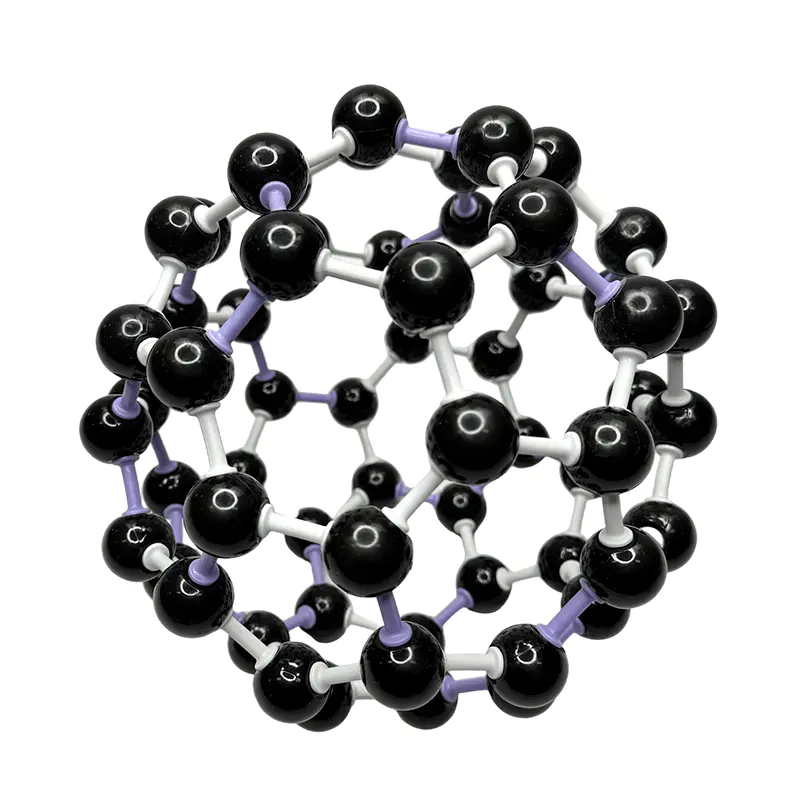
Plastic balls of different colors represent atoms/ions in the crystal, and white connecting rods represent intermolecular forces or covalent bonds. They are detachable and assemblable, visually displaying the arrangement of particles inside the unit cell, coordination number, and unit cell parameters, helping students understand the periodic spatial structure of crystals.

Identification of 4 Unit Cell Models:

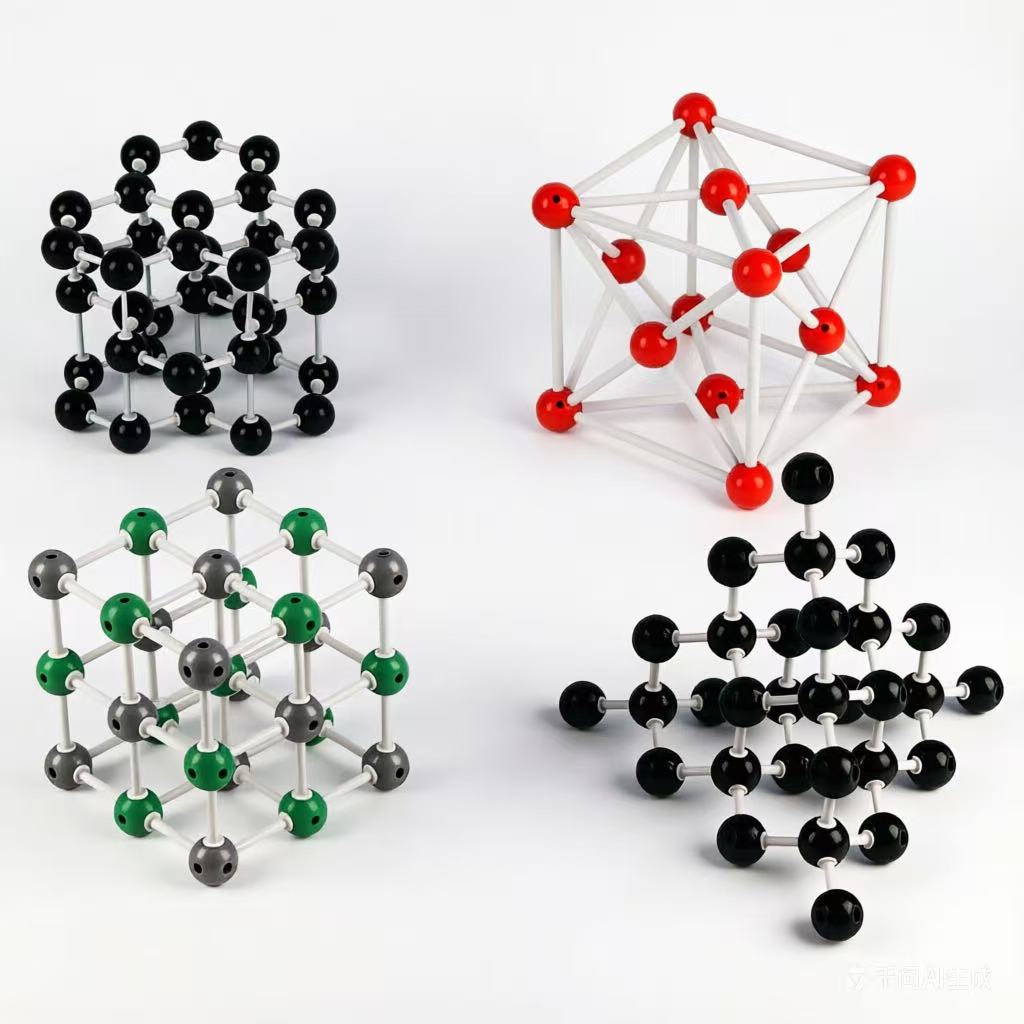
Diamond Unit Cell (Atomic Crystal): Black balls represent carbon atoms, displaying the tetrahedral spatial network structure of diamond. Students can observe that the coordination number of carbon atoms is 4, and understand the covalent bond network framework of atomic crystals. Face-Centered Cubic Unit Cell (General Framework for Metallic Crystals/Ionic Crystals): Red balls represent particles, displaying face-centered cubic packing, which is the basic packing form of metallic copper, sodium chloride, and other ionic crystals. Sodium Chloride NaCl Unit Cell (Ionic Crystal): Green and gray balls represent Na+ and Cl- respectively, demonstrating the alternating arrangement of ions, helping students understand that the coordination number of ionic crystals is 6, and the sharing calculation of ions in the unit cell. Graphite Crystal Structure (Mixed-Type Crystal): Black balls are carbon atoms, displaying the planar six-membered ring structure within graphite layers and the gaps between layers, explaining graphite's electrical conductivity and interlayer sliding characteristics.

Product Features:

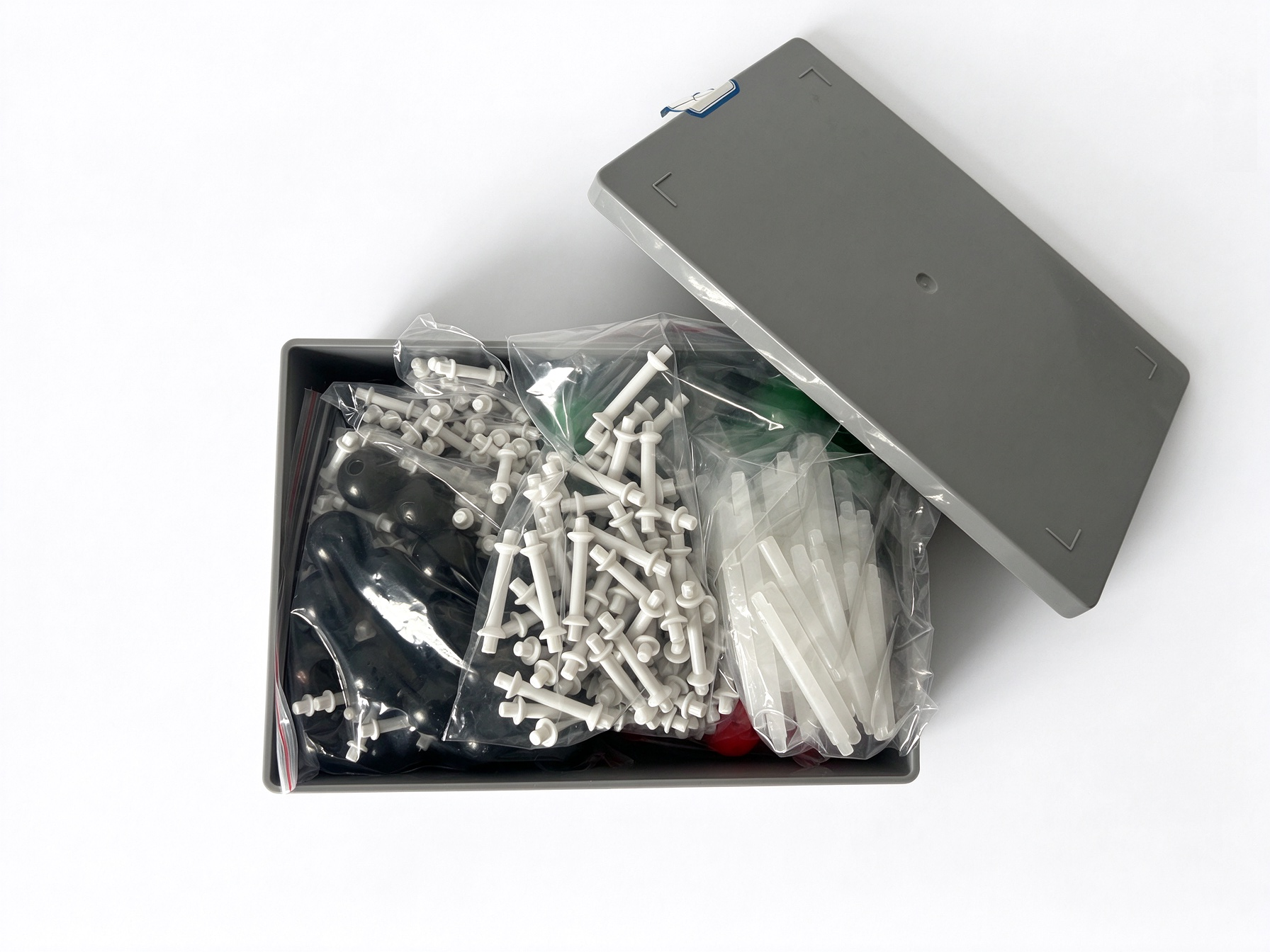
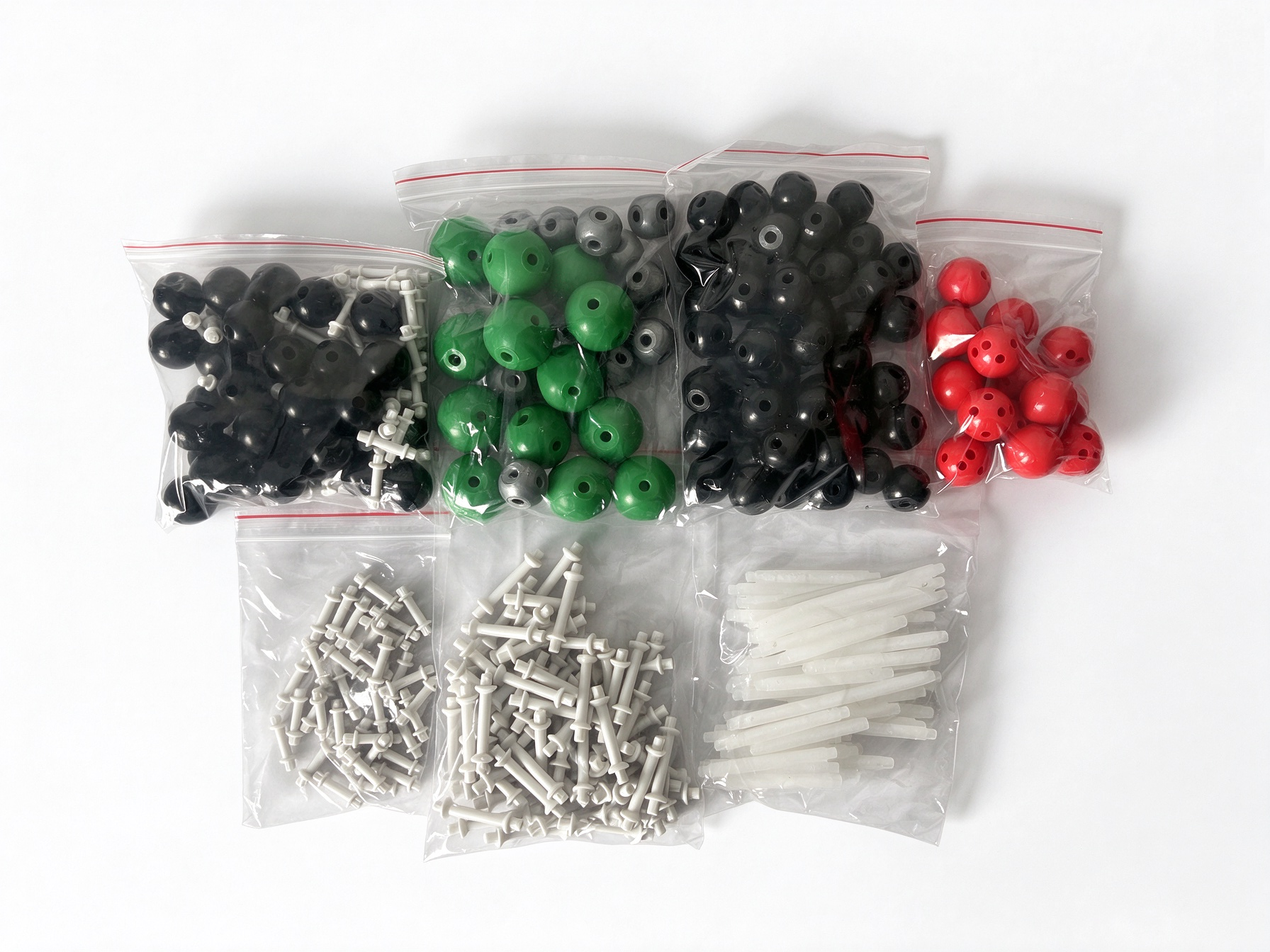
Plastic atom balls + pluggable connecting rods, easy to assemble and disassemble; balls have multi-directional holes, suitable for three-dimensional spatial arrangement of crystals; One set includes multiple typical unit cells: diamond, graphite, sodium chloride, face-centered cubic, and other classic crystals required by middle school curriculum standards; Equipped with a storage box, each component stored in separate bags; Solves difficulties: Students find it hard to imagine the three-dimensional space of unit cells from two-dimensional planar diagrams. It can be used for teaching knowledge points such as unit cell particle number calculation, packing modes, and coordination number.

Assembly Steps:

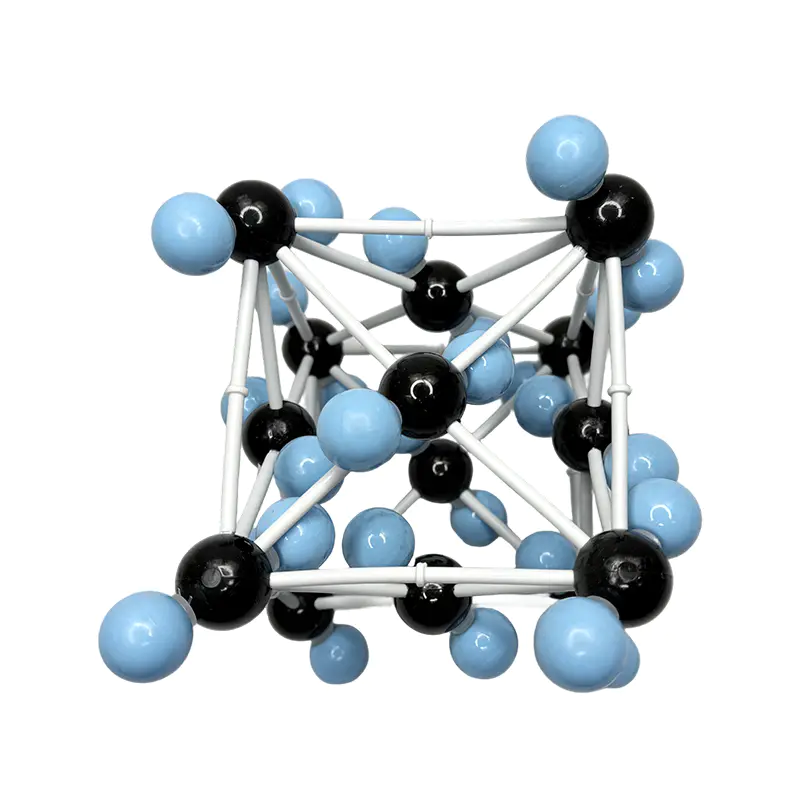
Graphite Model: First assemble a single-layer hexagonal carbon ring (6 C atoms + 6 short rods), then stack multiple layers, using long rods to connect between layers (simulating van der Waals forces). Diamond Model: Start with one C atom as the center, connect four C atoms to form a tetrahedron, and repeatedly expand into a three-dimensional network (maintain a bond angle of 109.5°). Sodium Chloride Model: First construct the face-centered cubic unit cell of Cl- (8 vertices + 6 face centers), then insert Na+ at the body center and edge centers (total of 4 Na+ ions). Carbon Dioxide Model: Connect two red O atoms to both sides of the black C atom using double bonds (long rod + spring), forming a linear shape (bond angle 180°).

Teaching Uses:

Classroom demonstration: Explaining the structural differences among ionic crystals, atomic crystals, metallic crystals, and mixed-type crystals; Student experiments: Hands-on construction of unit cells, practicing the sharing method to calculate the number of particles in a unit cell; Understanding core concepts such as close packing, coordination number, crystal lattice, and unit cell.

About Us
Yuyao Xueyou Teaching Equipment Co., Ltd.
Yuyao Xueyou Teaching Instrument Co., Ltd., established in 2008, is a comprehensive enterprise specializing in the research, development, production, sales, and service of teaching instruments. The company is located in Yuyao City, Ningbo, Zhejiang Province, benefiting from an excellent geographical location and convenient transportation, which provides strong support for the company's business development.

As a professional OEM Chemical Crystal Structure Model (Unit Cell Model) Manufacturers and ODM Chemical Crystal Structure Model (Unit Cell Model) Factory, The company boasts modern production facilities and advanced equipment, covering an area of 10,000 square meters. It has gathered a group of highly qualified professionals, including R&D engineers, technical workers, and a marketing team, who possess rich industry experience and an innovative spirit, providing a solid foundation for the company's continuous development. The company is a member of the China Educational Equipment Industry Association and has obtained ISO9001:2008 Quality Management System Certification, ISO14001:2004 Environmental Management System Certification, and GB/T28001-2001 Occupational Health and Safety Management System Certification. It has also been honored with numerous awards for quality and reputation in Zhejiang Province and Ningbo City.

The company's main products cover teaching instruments for various subjects such as physics, chemistry, biology, mathematics, and geography, with a complete range of varieties and specifications to meet the teaching needs of different levels and types of schools. We focus on product innovation and R&D, continuously launching new products with independent intellectual property rights to enhance teaching effectiveness and students' learning interest. At the same time, the company provides comprehensive pre-sales consultation, in-sales support, and after-sales service to ensure that customers receive timely and professional assistance during the purchase and use process.

We specialize in custom Chemical Crystal Structure Model (Unit Cell Model) and other teaching equipment, The company's products not only occupy a significant share in the domestic market but are also exported to more than thirty countries and regions, including Europe, America, Russia, the Middle East, Southeast Asia, Africa, and South America. The quality and reputation of our products have been consistently praised by customers both at home and abroad. Upholding the corporate spirit of "integrity, innovation, cooperation, and win-win," and with the mission of "providing high-quality equipment for education and supporting the comprehensive development of students," the company continuously strives for excellence and is committed to becoming a leading domestic and internationally renowned supplier of teaching instruments. We look forward to collaborating with more educational institutions and partners to jointly promote the development of the education industry.
Certificate Of Honor
  • Trademark registration certificate
  • Quality Management System Certificate-Chinese
  • Quality Management System Certificate-English
  • Environmental Management System-Chinese
  • Environmental Management System-English
  • Occupational Health and Safety Management System-Chinese
  • Occupational Health and Safety Management System-English
  • Business license
  • Membership certificate of China Educational Equipment Industry Association
  • Utility Model Patent Certificate
  • SGS certification
News