2026-10-30
Content
A solid cube sitting next to a photo of the same cube will still get called "six squares" by plenty of nine-year-olds. That is the point where a purchasing decision actually matters. Buy physical 3D geometry models when the lesson depends on handling the object: counting edges, unfolding a net, pouring water to compare capacity, or slicing through a solid to see the cut face. Skip them where an animation or a paper net already does the job, and put the saved budget into the few models that carry an entire topic for years.
What follows is a buyer's view rather than a lesson plan: which builds suit which geometry task, how transparent and solid models behave differently on a desk, the tolerances worth measuring before you sign a purchase order, and the failure points that quietly empty a school's model cupboard by the second term.
School geometry is a vocabulary problem before it is a calculation problem. A cube has 6 faces, 12 edges and 8 vertices; a square-based pyramid has 5 faces, 8 edges and 5 vertices. Students who only ever see these numbers printed will memorise them for a test and lose them by the next unit. Students who count the edges with a fingertip usually keep them.
The same applies to structure. Euler's formula, vertices minus edges plus faces equals 2, holds for the cube (8 − 12 + 6 = 2) and can be tested on every convex solid in the tray. Nets become real when a hollow solid can be cut along its edges and flattened; a cube has 11 distinct nets, and most classes will find six or seven before running out of ideas. Cross-sections stop being abstract when a cylinder is cut parallel to its base and produces a circle, then cut at an angle and produces an ellipse.
Handling is the common factor in all three cases. When you evaluate a set, ask whether the model lets a student do something a screen cannot: fill it, open it, flatten it, or cut it. If the answer is no, the model is decoration.
Model sets are usually sold as a number of pieces rather than as a capability. Work backwards from the lesson instead, then check the last column before ordering, because each build fails in its own predictable way.
| Model build | Best for | What students can do | Purchase caution |
|---|---|---|---|
| Hollow transparent solid with removable lid | Volume, capacity, interior structure | Fill with water, rice or unit cubes and compare | Lid fit and seam leaks; thin walls crack at the rim |
| Solid opaque solid | Naming, sorting, face and edge counting | Hold, roll, stack and trace around faces | Sharp edges; worn paint that hides corner count |
| Decomposable or segmented model | Composite solids, part-to-whole volume | Pull apart, rebuild, add the volumes of the parts | Joints loosen with use; small parts vanish between sets |
| Unit-cube and stackable block sets | Volume, layers, place value | Build prisms and count layers rather than guess | Edge-length drift between batches breaks the 1 cm assumption |
| Wooden geometric blocks | Early years, tactile sorting | Compare weight, roll, stack and balance | Moisture swelling and chipped corners |
| Cross-section slice sets | Plane cuts, cross-section shapes | Separate slices and inspect the cut face | Thin slices warp; magnetic alignment weakens |
Most schools need two or three builds, not six. A transparent filling set plus a decomposable set covers volume work from primary through lower secondary, and a stackable unit-cube set covers the layer-counting stage in between.
Transparent hollow acrylic is the only build that lets a class see volume as occupied space rather than as a number produced by a formula. A 10 cm cube filled with water holds one litre; a 1 cm unit cube holds one millilitre. That single demonstration does more for capacity teaching than a week of worksheets, but only if the lid seals well enough to survive being carried across a classroom.
Solid models are cheaper, more robust and better suited to younger hands, and they are fine for face and edge counting. Their weakness is volume: a student holding a solid cube learns the formula, not the idea. Colour also matters more than catalogues admit. Keep one convention across the whole set, for example all prisms in one colour and all pyramids in another, so students sort by geometric property instead of by decoration. Mixed colours with no logic teach nothing and make tidying up slower.
Size is the third variable. Solids around 8 to 10 cm tall fit a small hand and a standard desk tray, and a full class can handle them without crowding. Anything above 20 cm belongs to teacher demonstration only; it is awkward for students and hard to store.
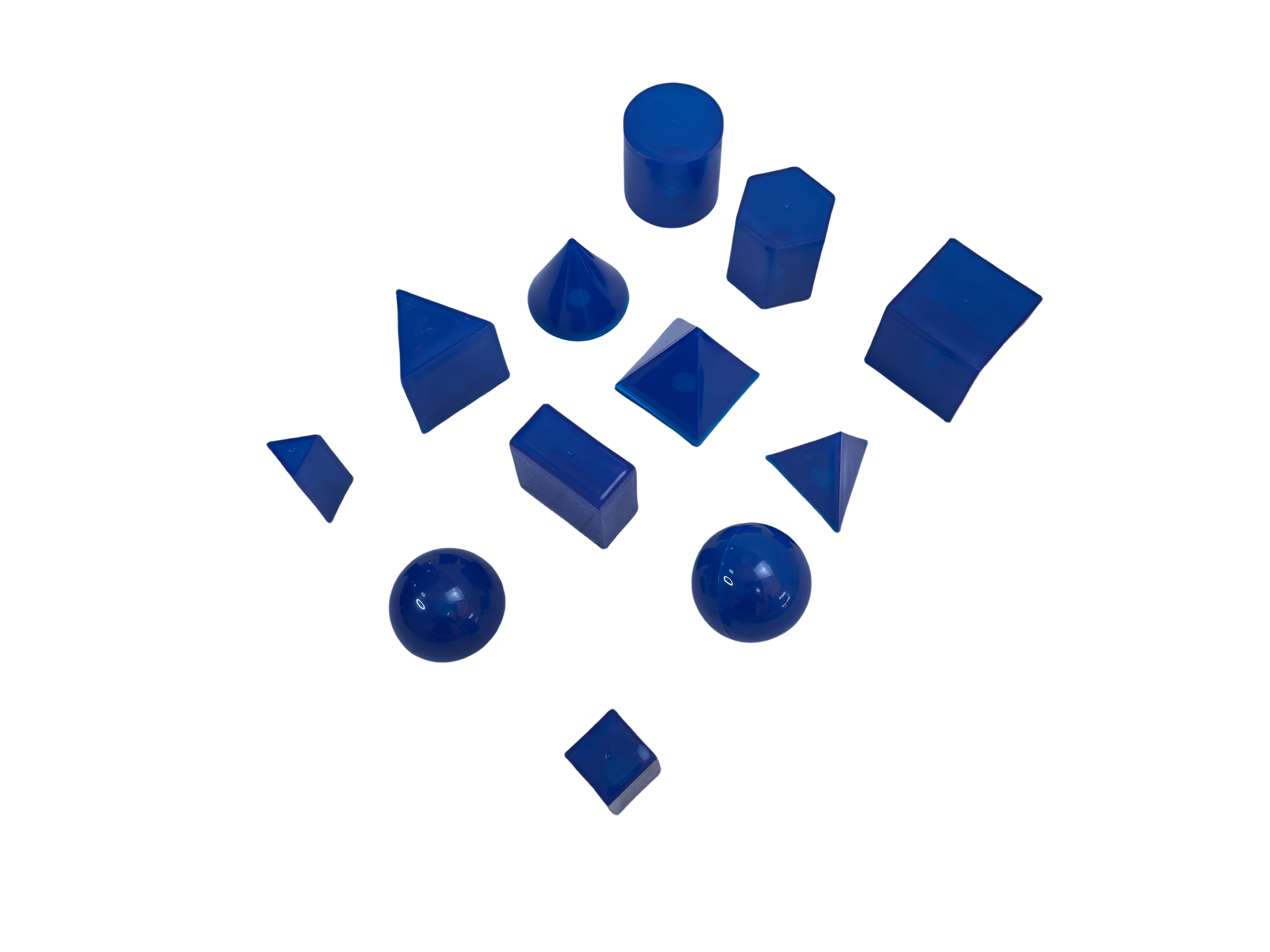 12-Piece Transparent 3D Geometric Solid Model SetA 12-piece transparent plastic geometry set including cylinder, cube, rectangular prism and cone; compact and light enough to consider as a staged classroom purchase.View Product →
One oversized kit bought for a whole school usually ends up locked in the science office because no single teacher can carry it. Buy in stages instead:
For the youngest band, wooden blocks remain the sensible default because they survive dropping, sit quietly on a desk and give useful weight feedback when students compare a cube with a sphere. Check corner rounding before ordering: a chipped wooden corner becomes a sharp edge within a term.
 Custom 12-Piece Wooden Geometric Solid Block SetA 12-piece wooden geometry teaching set with cubes, cylinders, cones and prisms; request a sample to compare physical sets before ordering.View Product →
Two sets can look identical in a catalogue photo and behave completely differently after a month of daily use. Ask for samples and work through the list below; most of it takes under twenty minutes with a steel rule and a bench.
Suppliers who manufacture their own tooling usually answer tolerance questions directly and can quote a batch consistency figure. Those are the questions worth putting in writing to the supplier's technical team before the tender closes.
A model earns its cost through repeated use, not through being impressive on arrival. These five routines work with almost any set and can be run in a single 40-minute lesson each.
 8-Piece Decomposable 3D Geometry Model SetEight-piece plastic geometry set with decomposable, expandable surfaces for demonstrating volume and surface area; plan labelled storage and careful stacking.View Product →
Sets are abandoned for boring reasons: a missing lid, three lost unit cubes, a tray nobody labelled. Plan the storage at the same time as the purchase. One labelled tray per set, a count sheet taped inside the lid, and a check at the start and end of every term will keep a class set usable for years. Store acrylic away from direct sunlight and radiators, ideally between 15 and 25 degrees Celsius, and keep solids out of a stack where weight can distort a thin wall.
Cost per lesson is the number that matters, not cost per box. A 12-piece set used twice a week for six years costs very little per session; a 60-piece set used once a term because it is heavy and confusing costs far more, even at half the price. Replacement units, not replacements of the whole set, are the figure to confirm at order stage.
Eight to twelve distinct solids is enough for a full primary and lower secondary curriculum. Beyond that, students spend lesson time sorting pieces instead of comparing properties. Add specialised shapes, such as cross-section slices, as a separate set.
Transparent and hollow, with a lid that seals. Volume only becomes intuitive when the space inside can be filled and compared. Solid models are more durable and better for face, edge and vertex work, so most schools benefit from both.
Roughly 8 to 10 cm in the largest dimension for student handling, with larger demonstration models kept for teacher use. Small sets under 5 cm are easy to store but hard to count with, particularly for younger students.
They are useful for one-off shapes and design projects, but print tolerances, layer lines and material wear make them unreliable as a class set for volume measurement. Injection-moulded or machined models hold their dimensions across a whole tray, which is what stacking and filling exercises depend on.
Label the tray, tape a count sheet inside the lid, and order spares with the original purchase. A missing lid effectively retires an otherwise perfect model, and spare small parts cost a fraction of a replacement set.
Buy a model when the lesson requires filling, unfolding, slicing or splitting, and buy it in the build that supports that one action. For most schools that means a transparent hollow set for volume, a decomposable set for composite solids, a unit-cube set for layer counting, and a small wooden set for early years. Everything else is optional and can wait a year.
Then check the details that decide whether the set survives: edge finish, base flatness, joint tolerance, dimensional consistency within the tray, and the availability of single replacement units. A carefully chosen 12-piece set will outlast three large kits bought on piece count alone. The wider mathematics teaching instrument range is a reasonable place to compare builds side by side before finalising quantities for each grade band.
Recommended Products



+86-18630650508 +86-0574-62500588

+8618630650508

 No. 588, Chaoyang South Road, Ditang Street, Yuyao, Ningbo City, Zhejiang Province, China


 English
 русский
 Español
