2026-09-25
Content
If your school laboratory has ever lost a rack of beakers in one afternoon, you already know that labware choice is not a cosmetic decision. A single dropped 250 mL borosilicate beaker can remove a week of experiment time from a chemistry class. At the same time, a plastic graduated cylinder that warps near a hot plate can quietly ruin a titration exercise. The real question is not whether glass is better than plastic, but which material belongs in which part of a school lab.
The short answer: use borosilicate glass for heating, accurate measurement, and aggressive chemical exposure; use plastic labware for routine mixing, storage, student handling, and anything that would otherwise create a breakage risk. The rest of this guide explains the reasons, the tolerances, and the procurement trade-offs behind that rule.
Borosilicate glass 3.3 is the benchmark for laboratory glassware because it combines low thermal expansion, high chemical durability, and optical clarity. Plastic labware is not a single material either: polypropylene, polyethylene, polystyrene, and PMP behave very differently. A school lab that buys only glass will spend too much on replacement and injury prevention. A school lab that buys only plastic will struggle with heating, accurate volume work, and solvent compatibility.
Use this task-level rule when planning purchases:
If you need to equip a full teaching lab rather than a research bench, start with a mixed inventory. A request a quote conversation with your supplier should cover both materials, not force a single-material catalog.
Borosilicate glass 3.3 is a Type I glass with roughly 80% silicon dioxide and about 13% boron trioxide. Its defining property is a coefficient of linear thermal expansion of approximately 3.3 × 10⁻⁶ per Kelvin, which is why it can survive rapid temperature changes that would crack ordinary soda-lime glass. In practice, a good 3.3 borosilicate beaker can handle a thermal shock of around 120°C to 150°C, depending on wall thickness and condition.
The material also resists most acids, salt solutions, and organic solvents. It is not perfect: hydrofluoric acid attacks glass, and hot concentrated alkalis will gradually etch the surface. For school use, those limits matter mainly in storage and waste handling, not in routine acid-base experiments.
For a school lab, this composition translates into three practical benefits: beakers and flasks can be heated directly, volumetric glassware holds its calibration over years, and the surface does not absorb dyes or odors the way many plastics do. A borosilicate glass funnel, for example, is a common workhorse for filtration because it tolerates hot liquids and cleans fully between classes.
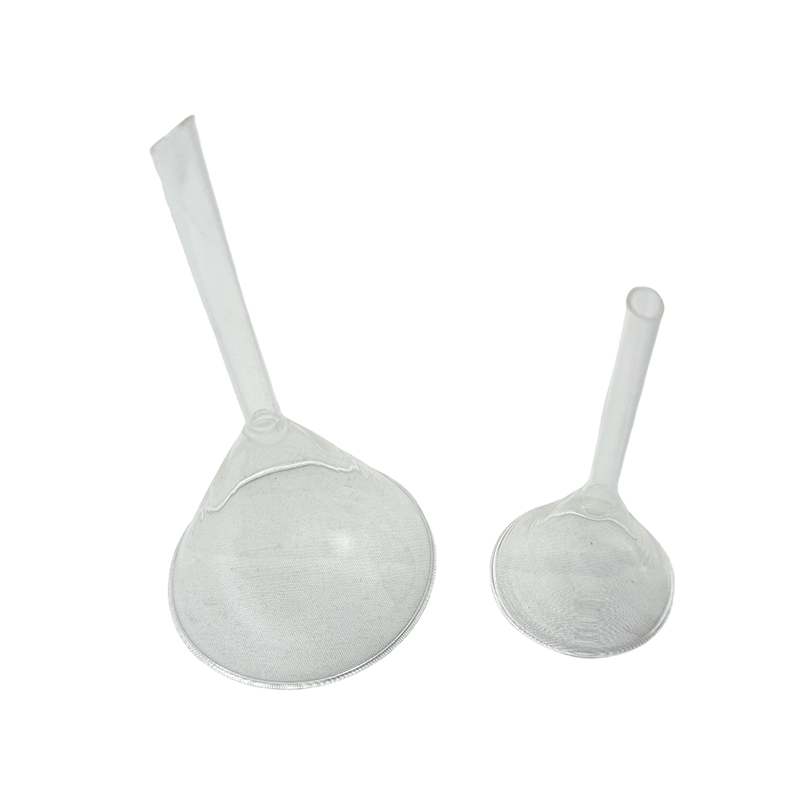 Laboratory glassware, conical glass funnelJunior high school chemistry experimental equipmentView Product →
Polypropylene (PP) is the most common plastic in school labs. It handles temperatures up to about 120°C, resists most acids and bases, and survives autoclaving. It is translucent rather than transparent, so it is a poor choice for color-change observation. Polyethylene (PE) is softer and more flexible, often used for wash bottles and squeeze bottles. Polystyrene (PS) is clear and rigid but brittle, and it cannot handle high temperatures or many solvents. PMP (polymethylpentene) is a higher-cost plastic that remains transparent and can withstand around 150°C, making it useful for some hot-liquid handling where glass breakage is a concern.
Plastic labware wins on weight, breakage resistance, and cost per unit. A polypropylene beaker can be dropped on a tile floor with no risk of flying glass, which matters in classrooms with younger students. It also does not shatter into sharp fragments, reducing injury risk and cleanup time.
The trade-offs are real. Plastics can scratch, stain, and absorb chemicals over time. They have lower dimensional stability at high temperatures, and most plastic volumetric ware carries a lower accuracy class than glass. For routine mixing and storage, those limits are acceptable. For quantitative chemistry, they are not.
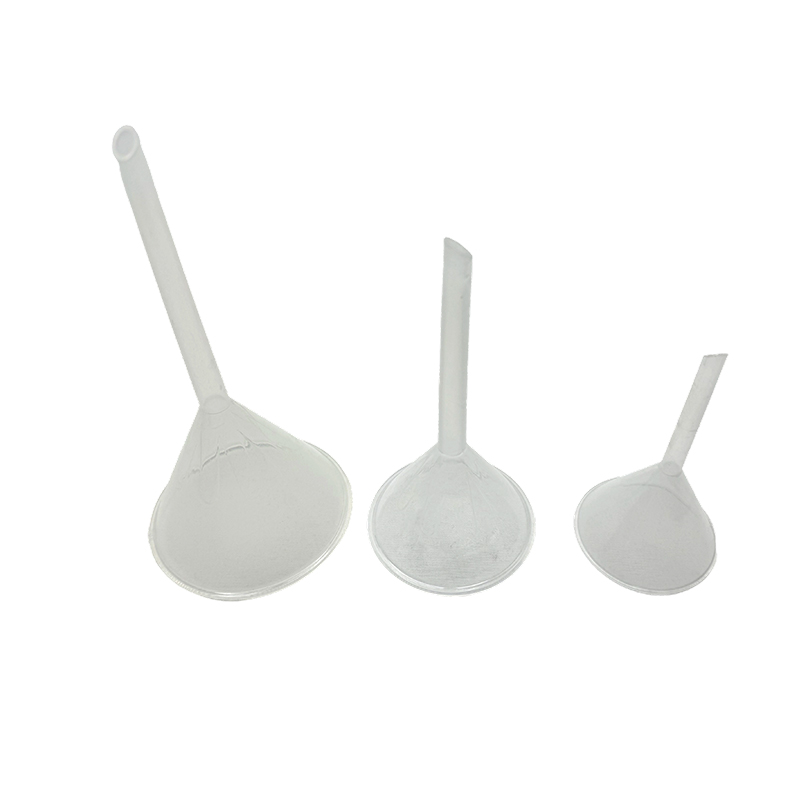 Laboratory plastic funnelJunior high school chemistry experimental equipmentView Product →
| Property | Borosilicate Glass 3.3 | Polypropylene (PP) | Polycarbonate (PC) |
|---|---|---|---|
| Maximum continuous service temperature | Around 450°C | Around 100–120°C | Around 115–130°C |
| Thermal shock resistance | Excellent, roughly 120–150°C | Poor for rapid changes | Moderate |
| Chemical resistance | Strong acids and solvents; attacked by HF and hot alkali | Good for bases and HF; limited for strong oxidizers | Limited; attacked by alkalis and some solvents |
| Breakage risk | High if dropped | Low | Low to moderate |
| Optical clarity | High | Translucent | High |
| Relative cost per unit | Higher | Lower | Moderate |
| Typical school use | Heating, volumetric work, filtration | Storage, mixing, student handling | Safety shields, some measurement |
Thermal shock is the fastest way to destroy glassware. A beaker that is safe at 400°C can still crack if it is moved from a hot plate to a cold wet bench. Borosilicate 3.3 tolerates that transition far better than soda-lime glass, but it is not indestructible. Chipped rims and deep scratches create stress points that fail later. Inspect glassware before every heating session and retire any piece with visible damage.
Chemical resistance follows a similar pattern. Glass is the default for acids and organic solvents, but it should not store hydrofluoric acid or hot concentrated sodium hydroxide. Polypropylene is the better choice for those specific chemicals. For mixed waste, check the compatibility of every component before pouring.
Measurement accuracy is where the material gap becomes a teaching issue. Class A borosilicate volumetric flasks and pipettes are calibrated to tight tolerances, often within ±0.02 mL for a 25 mL pipette. Most plastic graduated cylinders are Class B and have wider tolerances. A plastic cylinder is fine for approximate volumes, but not for preparing standard solutions.
Glass breakage is the leading cause of labware replacement in schools. It is also a safety incident waiting to happen: broken glass cuts, and hot broken glass is worse. Plastic labware reduces that risk substantially. For a class of 30 students moving around benches, polypropylene beakers and plastic stirring rods can absorb accidental impacts that would shatter glass.
But total cost is not just the purchase price. Borosilicate glass lasts longer under normal use, resists staining, and can be cleaned at high temperatures. Plastic scratches, retains odors, and may need replacement sooner if students use abrasive brushes. A careful school lab projects review usually shows that the lowest lifetime cost comes from a hybrid inventory: glass where precision and heat matter, plastic where safety and volume matter.
One practical budgeting rule: spend on glass for volumetric flasks, pipettes, burettes, and heating vessels; spend on plastic for beakers, storage bottles, trays, funnels, and student practice kits. That split protects both data quality and classroom safety.
Use the following sequence when writing a purchase specification or checking a stockroom order:
This task-first approach avoids the common mistake of buying one material for everything. It also makes replacement ordering faster because teachers know exactly which items must be glass and which can be plastic.
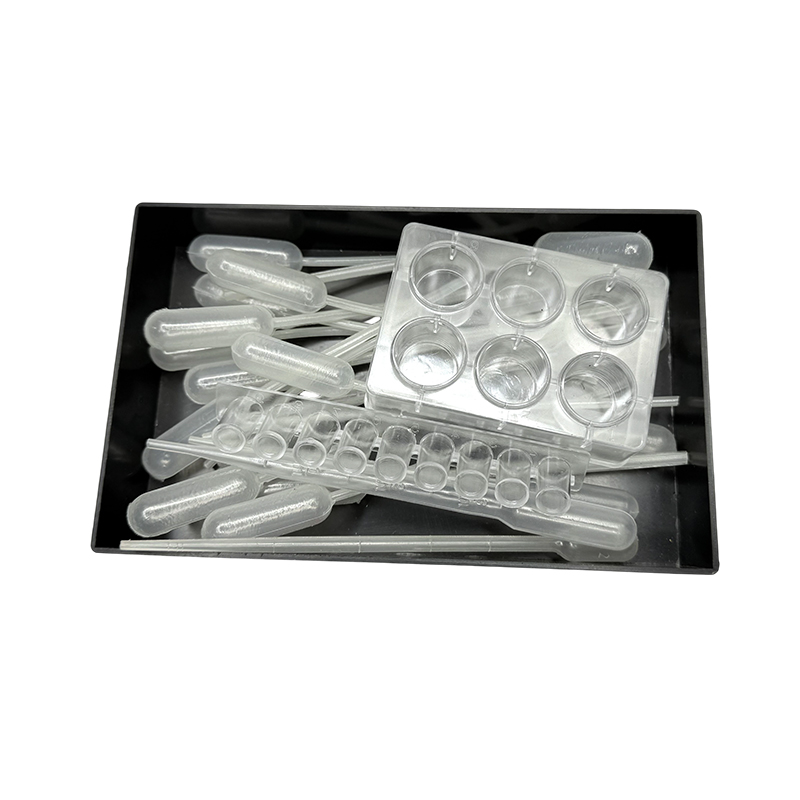 Laboratory plastic droppers and well plates are commonly usedJunior high school chemistry experimental equipmentView Product →
Even experienced buyers make predictable errors when comparing borosilicate glass and plastic labware. Watch for these:
A simple fix is to label storage shelves by material and task. For example, “heat only” glass shelves and “chemical storage” plastic shelves reduce accidental misuse by students and new staff.
Yes, borosilicate glass is generally microwave-safe because it has low thermal expansion and does not absorb microwave energy. Plastic labware should only be microwaved if the manufacturer explicitly rates it for that use.
Polypropylene resists many acids, including hydrofluoric acid, which attacks glass. However, strong oxidizing acids such as concentrated nitric acid can degrade some plastics over time. Check the specific resin and supplier guidance.
Class A borosilicate glass is more accurate. Plastic graduated cylinders are typically Class B and are best for approximate volumes, not for preparing standard solutions.
Glass remains essential for heating, optical clarity, and quantitative measurement. Plastic cannot replace those functions without compromising either safety or data quality. The practical answer is a mixed inventory, not a single-material rule.
Borosilicate glass vs plastic labware is not a contest with one winner. It is an inventory decision. Put glass where heat, accuracy, and chemical resistance are non-negotiable. Put plastic where breakage risk, cost, and student safety dominate. Then label the storage, train the teachers, and inspect glassware before every heating session. That approach keeps experiments running, budgets predictable, and classrooms safer.
Recommended Products


+86-18630650508 +86-0574-62500588

+8618630650508

 No. 588, Chaoyang South Road, Ditang Street, Yuyao, Ningbo City, Zhejiang Province, China


 English
 русский
 Español