2026-01-08
Content
In the world of science education, specifically within the realm of physics and electrical engineering, few tools are as fundamental as the ammeter. For students stepping into the laboratory for the first time, the sight of wires, power sources, and measuring gauges can be both exciting and a bit daunting. One of the most common questions educators and suppliers receive is: "What makes a good student-grade ammeter, and how does it help in learning about electrical circuits?"
Today, we are diving deep into the world of educational measurement tools, focusing on a staple of the classroom: the portable, high-visibility Equipment Ammeter. Whether you are a teacher looking to outfit your lab or a student trying to make sense of your latest experiment, understanding the mechanics and applications of this device is key to mastering electricity.
At its core, physics is the study of how the universe behaves. Electricity, one of the most practical branches of physics, relies on our ability to measure invisible forces. You cannot see electrons moving through a wire, but you can see the results of their movement. This is where the Equipment Ammeter comes in. It serves as the "eyes" for the student, translating the flow of electric charge into a physical movement on a dial.
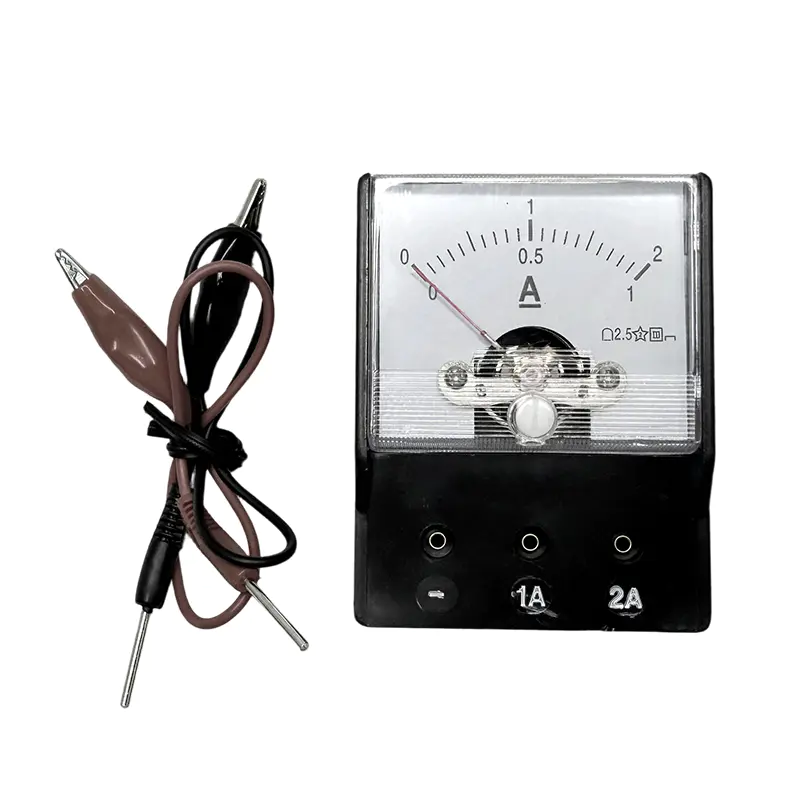
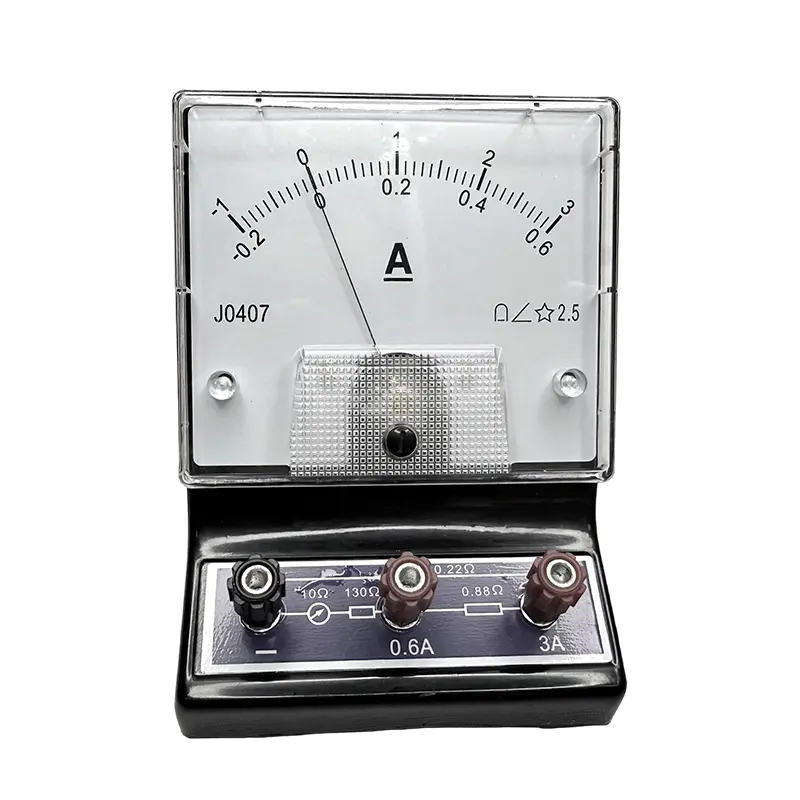
The Model X0001 ammeter is specifically engineered for the classroom, and its design reflects the unique needs of a learning environment. Unlike industrial ammeters that might be mounted in dark electrical panels, a student ammeter needs to be ergonomic and highly readable.
One of its standout features is that the indicator panel is set at a 45° angle to the horizontal plane. This might seem like a small detail, but in a busy classroom where students are often standing over a lab bench or sitting in groups around a single circuit, this angle is crucial. It minimizes glare from overhead fluorescent lights and ensures that the needle is visible from multiple vantage points without the student having to lean awkwardly over the live circuit.
When selecting equipment for middle schools and high schools, durability and precision must strike a delicate balance. The X0001 is built with a combination of metal and plastic, ensuring it is lightweight enough (only 76g) for easy storage and transport, yet sturdy enough to withstand the daily rigors of student use.
In the world of measurement, "Accuracy Class" is a vital metric. This device boasts an Accuracy Grade Index of 2.5. In simple terms, this means the maximum error of the meter is within 2.5% of the full-scale value. For student experiments—such as verifying Ohm’s Law or measuring the current in a series circuit—this level of precision is ideal. It provides reliable data that matches theoretical calculations while allowing for the small real-world variations that make lab work interesting.
The device offers two primary measurement limits:
1 Ampere (1A)
2 Amperes (2A)
By providing dual limits, students learn the importance of "range selection." They are taught to start with the higher limit (2A) to protect the device from surging current, and then switch to the more sensitive limit (1A) to get a more precise reading. This practice is a cornerstone of electrical safety and measurement methodology.
The "Grid Cycle" or scale division is another educational touchpoint.
At the 1A limit, each small grid represents 0.05A.
At the 2A limit, each small grid represents 0.1A.
This clear differentiation helps students practice reading analog scales, a skill that requires mental math and attention to detail—skills that are often lost in an era of digital-only displays.
While the primary function of this ammeter is to measure DC circuits in middle school physics, its application can sometimes cross over into interesting interdisciplinary fields.
Interestingly, the technical documentation for this series mentions its role in vital capacity test instruments. You might wonder: how does an electrical ammeter relate to human breathing? In advanced educational setups, sensors are used to convert the force of a person’s breath into an electrical signal. The ammeter then displays this signal, reflecting the respiratory function of the human body. This allows students to see a direct, measurable link between biological energy and electrical output, making the study of science feel more interconnected.
Laboratory equipment often has to live in non-climate-controlled storage rooms or busy, humid classrooms. The X0001 is designed to be resilient. It functions optimally in temperatures ranging from 0℃ to 40℃ and can handle a relative humidity of up to 85%.
This robustness ensures that whether the school is in a dry, cold climate or a humid, tropical one, the needle will move smoothly and the internal magnets will remain calibrated. This reliability is why it has become a go-to choice for educational departments worldwide.
In recent years, there has been a push toward digital simulations in science education. While software can simulate a circuit, nothing replaces the tactile experience of stripping a wire, tightening a terminal nut, and watching a physical needle deflect across a scale.
Using the Equipment Ammeter teaches students about:
Resistance: How adding components like bulbs or resistors changes the current flow.
Circuit Integrity: Identifying "breaks" in a circuit when the needle fails to move.
Safety: Understanding what "overload" means and how to prevent damage to sensitive components.
The inclusion of dedicated wires as accessories means that the equipment is "plug-and-play." Teachers don't have to spend precious prep time hunting for compatible leads. The compact size (808030mm) means a full class set of 30 units can be stored in a single small cabinet, making lab management efficient.
Recommended Products


+86-18630650508 +86-0574-62500588

+8618630650508

 No. 588, Chaoyang South Road, Ditang Street, Yuyao, Ningbo City, Zhejiang Province, China


 English
 русский
 Español