2026-01-15
Content
In the realm of biological sciences, there is a profound difference between reading about anatomy in a textbook and seeing the intricate structures of life firsthand. For generations, the dissection of biological specimens has been a cornerstone of science education, providing students with an unparalleled look at the complexity of living organisms. To facilitate this journey of discovery, high-quality instrumentation is non-negotiable.
The Veterinary Dissecting Kit and Student Dissection Tools (represented by the versatile X0899 series) have emerged as the gold standard for junior high school biology experiments. Designed to bridge the gap between amateur curiosity and professional precision, these kits provide the essential hardware needed to explore the wonders of biology safely and effectively.
Before diving into the specifics of the tools themselves, it is important to understand why these kits are so vital in a modern classroom. While digital simulations and 3D models have become increasingly sophisticated, they cannot replicate the tactile feedback of real tissue.
When a student uses a scalpel to reveal the chambers of a heart or uses forceps to trace the path of a nerve, they are engaging in "active learning." This process helps build fine motor skills, spatial reasoning, and a deeper respect for the complexity of life. A high-quality kit ensures that the student’s focus remains on the biology, rather than struggling with dull blades or flimsy handles.
A comprehensive dissecting kit is more than just a box of sharp objects; it is a curated collection of specialized instruments, each designed for a specific task. Depending on the level of the experiment, these kits usually come in 5-piece, 7-piece, or 9-piece configurations.
The scalpel is perhaps the most iconic tool in the kit. It consists of two parts: the scalpel handle and the replaceable scalpel blade.
The Handle: Usually made of high-quality metal with a textured grip to prevent slipping.
The Blade: These are incredibly sharp and intended for making clean, decisive incisions. In a student setting, the ability to replace blades ensures that the tool is always performing at its peak, which is actually safer than using a dull blade that requires more pressure to cut.
Scissors in a dissection kit are not like the ones you find in a craft drawer.
Straight Scissors: Used for long, straight cuts through skin or connective tissue.
Curved Scissors: These are vital for navigating around delicate organs without piercing them. The upward curve allows the user to see exactly where they are cutting, even in tight spaces.
Forceps are used to lift, move, or hold tissues aside so the student can see what lies beneath.
Straight Forceps: Ideal for picking up small structures or pulling away thin membranes.
Curved Forceps: Perfect for reaching under organs or grasping tissues from an angle that doesn't block the student's line of sight.
Often called "teasing needles," these tools are used for the most delicate work. They help separate fine layers of tissue (like muscle fibers) or point out specific structures during a practical exam without causing damage.
The Veterinary Dissecting Kit and Student Dissection Tools are manufactured using a combination of high-grade metal and durable plastic. The metal components—usually stainless steel—are resistant to corrosion. This is crucial because dissection often involves exposure to preservatives (like formaldehyde) and biological fluids.
The addition of "step" materials in the construction ensures that the tools are balanced. A well-balanced tool reduces hand fatigue during long laboratory sessions, allowing students to maintain their precision from the beginning of the class until the end.
These kits are specifically tailored for junior high school biology experiment equipment. At this educational stage, students are often introduced to the anatomy of earthworms, frogs, or fetal pigs.
The primary use of the dissector is the "cutting and peeling" of experimental materials. This involves removing the outer dermal layers to reveal the muscular and skeletal systems. Using the scalpel and straight scissors, a student can make the initial "I" or "Y" shaped incision, then use the forceps and curved scissors to peel back the skin carefully.
Once the internal cavity is exposed, the tools allow for the separation of the digestive, circulatory, and respiratory systems. By using the anatomical needle to move the liver or intestines aside, a student can trace the path of the esophagus or find the gallbladder—discoveries that turn an abstract diagram in a book into a tangible reality.
Working with sharp instruments requires a high level of responsibility. Teachers and students alike must adhere to strict safety protocols:
Always cut away from your body: This prevents accidental slips from causing injury.
Use the right tool for the job: Never use a scalpel for a task that requires scissors.
Proper Cleaning: After every use, tools should be cleaned, dried, and stored in their designated slots within the kit. This prevents rusting and ensures the kit is ready for the next class.
When selecting a kit, schools and parents must consider the complexity of the curriculum.
The 5-Piece Set: Perfect for introductory biology where basic identification is the goal.
The 7-Piece and 9-Piece Sets: These are better suited for advanced students who need specialized curved tools and multiple needle types for detailed exploration.
The modular nature of these specifications allows educational institutions to provide the right level of equipment without overcomplicating the learning process for beginners.
The Veterinary Dissecting Kit and Student Dissection Tools represent more than just "equipment." They are the keys to a world that most people never see. For a student, the first time they successfully identify a heart valve or a spinal cord using these precision instruments is often the moment they decide to become a doctor, a veterinarian, or a researcher.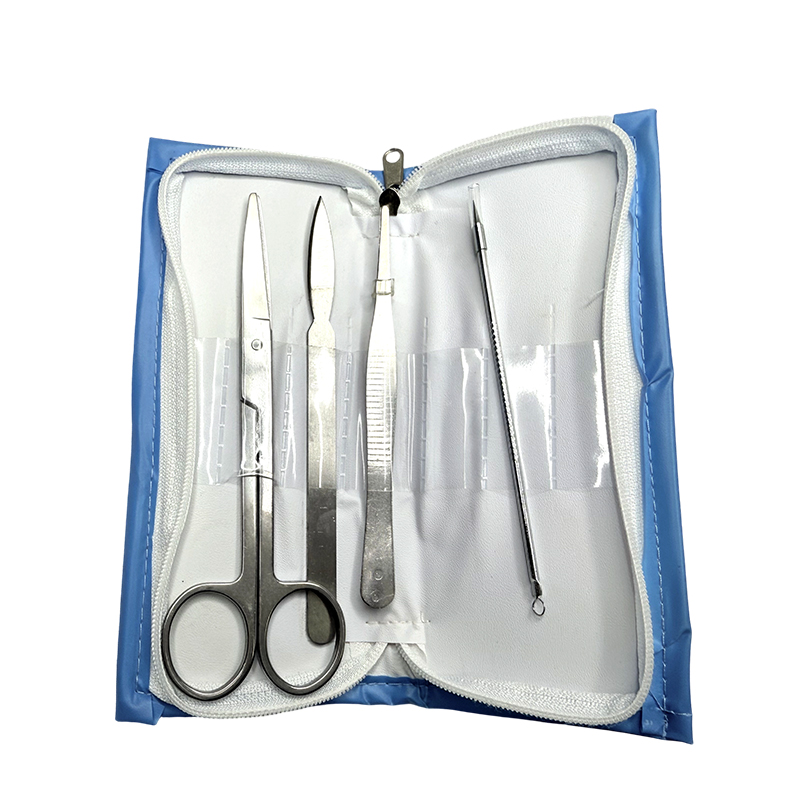
By investing in high-quality, durable, and ergonomically designed tools, we ensure that the next generation of scientists has the best possible start. Biology is the study of life, and there is no better way to respect that life than by studying it with the precision and care that these professional-grade kits provide.
| Tool Name | Primary Function | Best Used For |
| Scalpel | Slicing / Incision | Initial cuts and skinning |
| Curved Scissors | Trimming / Cutting | Navigating around organs |
| Forceps | Grasping / Lifting | Moving tissues to see underneath |
| Teasing Needle | Separating / Pointing | Delicate fiber separation |
| Straight Scissors | Heavy Cutting | Cutting through thick tissue or small bones |
Recommended Products


+86-18630650508 +86-0574-62500588

+8618630650508

 No. 588, Chaoyang South Road, Ditang Street, Yuyao, Ningbo City, Zhejiang Province, China


 English
 русский
 Español