2026-08-21
Content
A biology teacher planning an anatomy unit often faces the same dilemma: the human torso model and the skeleton model both sit on the approved supplier list, but the budget covers only one model this term. The practical answer is that they are not substitutes. A torso model shows what sits inside the body and how the organ systems interact; a skeleton model shows the framework that supports, protects, and moves the body. Choose by curriculum objective first, then weigh class size, storage space, and grade level.
We manufacture both model families, so we see, order after order, how schools put them to work. Classroom case studies and service records show a consistent pattern: when the model is matched to a specific teaching goal, the purchase delivers value immediately. This guide compares the two categories in practical terms so a science department head, lab technician, or procurement officer can decide with confidence.
A human torso model is a trunk-level replica that includes the head, chest, abdomen, and pelvis, with removable internal organs. Standard versions carry a detachable head, a chest and abdominal wall with muscles, and organ blocks for the heart, lungs, liver, stomach, intestines, and kidneys. Dual-sex models add a female mammary block and interchangeable reproductive organs, which is why they also appear in health education and first-aid training.
The teaching value is relational. Students see where the trachea passes in front of the oesophagus, how the lungs wrap around the heart, and how the liver sits beneath the diaphragm. Removing parts and fitting them back is a hands-on exercise that builds spatial memory more reliably than a poster or a screen.
A torso model earns its place in the lab when the lesson covers:
For a configuration that balances visibility and part detail, the 85cm human torso model with detachable simulated organs is a common fixture in junior and senior high biology rooms.
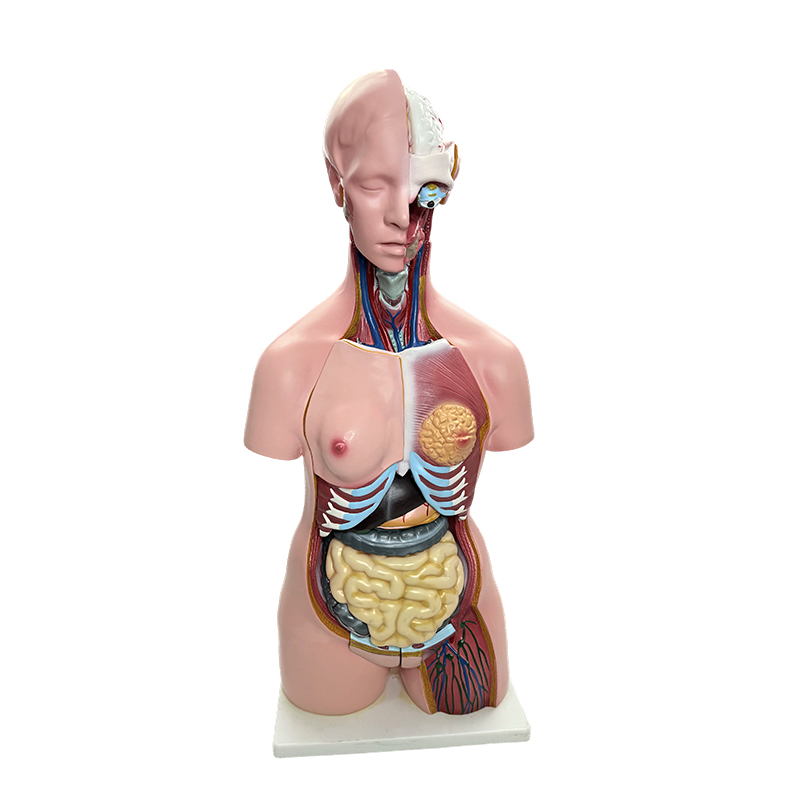 Custom Demonstration of human body gender, torso model simulation of human organAs a China ODM/OEM Demonstration of human body gender, torso model simulation of human organs, 85cm medical anatomy teaching manufacturer...View Product →
A skeleton model reproduces the bony framework: skull, rib cage, vertebral column, pelvis, and upper and lower limbs. It may be one articulated standing unit or a disarticulated set of individual bones for closer study. A full-size version lets an instructor point to the atlas and the axis, demonstrate the hinge action of the knee, and show why the femur is the longest bone in the body.
The teaching value is structural. Students learn bone names, joint types, posture, and the connection between skeletal form and movement. Because bone models carry fewer soft-tissue details, they stand up to frequent handling and are easier to keep clean.
Choose a skeleton model when the lesson covers:
Where the syllabus calls for a reference at true human scale, a life-size 170cm human skeleton model is the standard choice in secondary school biology rooms.
The two categories differ in more than appearance. The table below summarizes the points that usually decide a school purchase.
| Criterion | Human torso model | Skeleton model |
|---|---|---|
| Primary content | Internal organs and organ systems | Bones, joints, and skeletal landmarks |
| Typical part count | Usually 15 to 30 removable pieces | One articulated unit or 20+ individual bones |
| Core lessons | Physiology, organ relationships, health basics | Osteology, joint movement, body support |
| Classroom format | Teacher demonstration and small-group handling | Full-class demonstration; handles frequent study |
| Common size options | 65 cm, 85 cm | 42 cm, 85 cm, 170 cm life-size |
| Fragile points | Small organ blocks, trachea, cartilage | Facial bones, bone processes, stand connectors |
| Storage plan | Boxed trays for removable parts | Stand, case, or wall bracket |
| Best grade fit | Middle school to vocational and medical programs | Elementary to university-level anatomy |
The teaching emphasis also differs sharply. The chart below scores the two model types against the anatomy objectives that appear most often in school syllabuses.
Figure 1. Typical teaching emphasis by model type
Scored 1 to 5 based on the lesson types each model is designed to support.
For a classroom purchase, the selection logic follows the curriculum table rather than the price list. Match the model size and detail level to the age of the students and to the space you can give it.
For primary grades, keep the model sturdy and the concepts broad. A compact 42cm human skeleton model still communicates the skull, rib cage, and long bones clearly, and it slides onto an ordinary shelf without a display case.
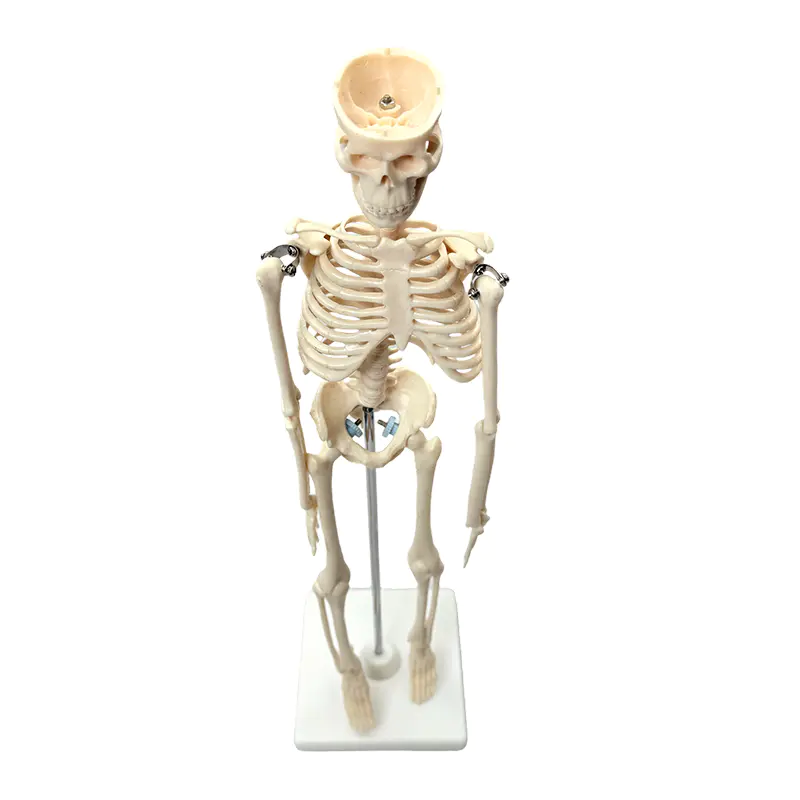 Custom Human skeletal model 42cm Manufacturers, OEM/ODM FactoryAs a China ODM/OEM Human skeletal model 42cm manufacturers and factory, Yuyao Xueyou Teaching Equipment Co., Ltd specialized in custom Hu...View Product →
The 65 cm and 85 cm torso models are the backbone of middle-school anatomy teaching because they cover the organ systems named in the biology syllabus. When bones are also on the plan, an 85 cm skeleton model works as a companion without taking over the laboratory.
Older students need precise bone landmarks and deeper organ detail. A full-size skeleton gives them a reference they will use through the whole year, while an 85 cm torso with sex-specific blocks adds the reproductive and endocrine structures that a basic model leaves out.
Order demand across school levels follows the pattern shown below.
Figure 2. Anatomy model demand by school level
Two cost risks define the long-term value of an anatomical model: lost parts and damaged connections. A few checks during procurement protect the investment.
These checks matter most for bulk orders. Suppliers that keep replacement organ blocks, vertebrae, and mounting pins in their production schedule reduce downtime when a part finally wears out.
No, not for the same lesson. The torso is built for organs and systems; the skeleton is built for structure and movement. Many schools buy one model each year across two budget cycles and end up with a complete lab.
An 85 cm model is large enough to be seen from the back of a typical classroom, and its detachable parts still fit on a teacher's desk for group rotation.
Standing articulated skeletons are assembled at the factory. The 42 cm and 85 cm versions sit on a compact base and require only minimal setup.
With normal handling, the durable PVC bodies last many years. The main wear points are mounting pins on torso models and stand connectors on skeletons; both are replaceable.
Yes. The skeleton line runs from a 42 cm classroom model to a 170 cm full-size unit, and the torso line includes 65 cm and 85 cm configurations.
The choice comes down to the story the model must tell. If the objective is how the body works as a living system, start with a torso model. If the objective is the framework that shapes and moves the body, start with a skeleton. For many secondary biology departments, a two-year acquisition plan - one model each year - builds a complete teaching set without a one-time budget shock.
When you are ready to compare part lists, sizes, and pricing against your syllabus, contact our sales team. We will help you match the model specification to the teaching plan, including the spare parts schedule.
Recommended Products



+86-18630650508 +86-0574-62500588

+8618630650508

 No. 588, Chaoyang South Road, Ditang Street, Yuyao, Ningbo City, Zhejiang Province, China


 English
 русский
 Español