The Core Equipment Every Chemistry Lab Cannot Do Without
A functional chemistry lab — whether a school teaching lab or a professional research space — requires three core categories of equipment: chemical glassware for containing and reacting substances, measurement instruments for accuracy, and safety supplies for protecting users. Without these three pillars, no meaningful experiment can be safely or accurately conducted. Below is a complete breakdown of every essential item, organized by function.
Chemical Glassware: The Foundation of Every Experiment
Chemical glassware is the most visible and frequently used category in any chemistry teaching lab. All standard glassware is made from borosilicate glass, which withstands temperatures above 500°C and resists chemical corrosion.
| Glassware |
Primary Use |
Typical Sizes |
| Beaker |
Mixing, heating, and holding liquids |
50 mL – 2000 mL |
| Erlenmeyer Flask (Conical Flask) |
Titration, mixing without spillage |
100 mL – 1000 mL |
| Test Tube |
Small-scale reactions and sample storage |
10 mm × 75 mm – 25 mm × 200 mm |
| Graduated Cylinder |
Measuring liquid volumes accurately |
10 mL – 1000 mL |
| Burette |
Delivering precise liquid volumes in titration |
25 mL / 50 mL |
| Pipette |
Transferring exact volumes of liquid |
1 mL – 25 mL |
| Round-Bottom Flask |
Distillation, reflux reactions |
100 mL – 2000 mL |
| Watch Glass |
Evaporation, covering beakers, weighing solids |
50 mm – 150 mm diameter |
| Petri Dish |
Sample observation, crystal growth |
60 mm – 150 mm diameter |
| Condenser |
Cooling vapors in distillation setups |
200 mm – 400 mm |
For school chemistry teaching instruments, a standard classroom set typically includes at least 20 beakers, 30 test tubes, 10 Erlenmeyer flasks, and one complete titration kit (burette + pipette + stand) per 8–10 students.
Heating and Combustion Equipment
Controlled heat is central to most chemical reactions. The right heating apparatus determines both safety and experimental precision.
- Bunsen Burner — The standard heat source in school labs. It burns natural gas or propane and can reach approximately 1,500°C at the hottest point of its flame. Used for heating liquids, sterilizing equipment, and combustion experiments.
- Alcohol Lamp — A safer alternative for schools with no gas supply. Burns ethanol at a lower temperature, making it suitable for gentle heating tasks.
- Hot Plate / Heating Mantle — Electric heating devices used when open flames are unsuitable, especially when working with flammable solvents. Hot plates support beakers up to 2,000 mL.
- Tripod Stand and Wire Gauze — Support structures that hold glassware above a flame. The wire gauze distributes heat evenly to prevent cracking.
- Clay Triangle — Holds crucibles over a flame for high-temperature heating of solid samples.
Measurement and Analysis Instruments
Precision is non-negotiable in chemistry. The following laboratory instruments and apparatus are essential for collecting reliable, reproducible data:
- Analytical Balance — Measures mass to 0.0001 g accuracy. Anti-vibration balance tables are recommended in school settings to reduce measurement error from table movement.
- Laboratory Thermometer — Measures temperatures from -10°C to 110°C (standard range). Used for monitoring reaction temperatures, boiling points, and water bath conditions.
- pH Meter — A digital instrument that measures the acidity or alkalinity of a solution with a precision of ±0.01 pH units. Far more accurate than litmus paper for quantitative analysis.
- Litmus Paper / Indicator Paper — A quick qualitative test tool to determine whether a solution is acidic or basic. Red litmus turns blue in bases; blue litmus turns red in acids.
- Stopwatch / Timer — Essential for reaction kinetics experiments, where timing directly affects results.
- Educational Microscope — Enables observation of precipitates, crystals, and microstructures formed during chemical reactions. Standard school microscopes magnify between 40x and 400x.
Chemistry Teaching Models and Visual Aids
Beyond hands-on apparatus, chemistry teaching models play a critical role in helping students visualize molecular structures and chemical processes that cannot be observed directly.
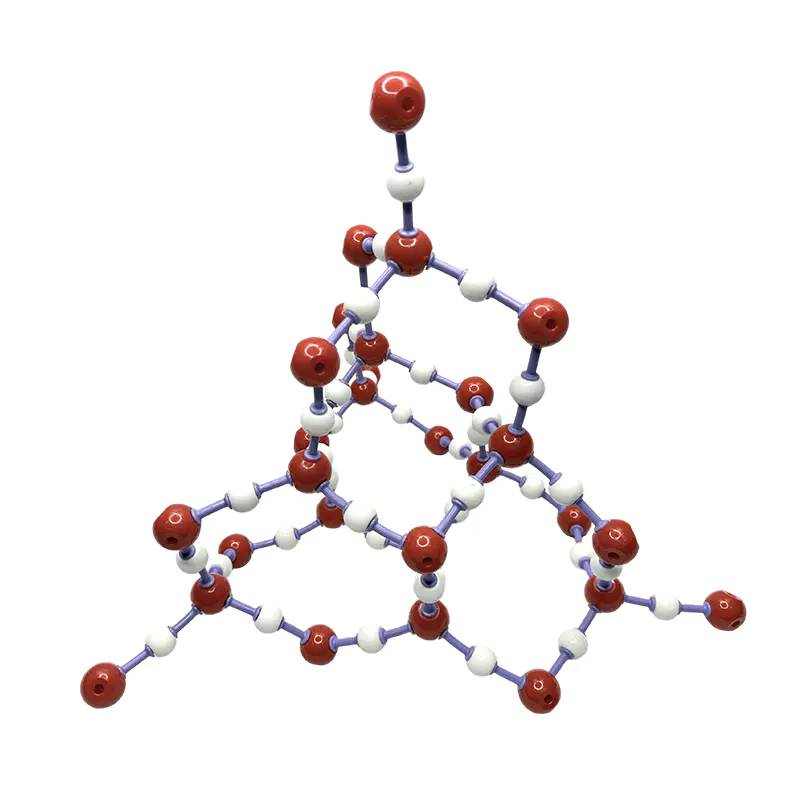
- Molecular Model Kits — Ball-and-stick or space-filling models that represent atoms and bonds in 3D. Students use these to build molecules such as water (H₂O), methane (CH₄), and benzene (C₆H₆).
- 3D Periodic Table — An interactive display showing element groups, periods, and atomic numbers. Helps students understand periodicity, reactivity trends, and element classification at a glance.
- Atom Structure Models — Demonstrate electron shell configurations for different elements, linking directly to bonding and reactivity concepts.
- Wall Charts and Reaction Diagrams — Durable educational charts illustrating reaction types, laboratory safety rules, and equipment identification guides.
Support Equipment and Lab Accessories
These items are often overlooked in initial procurement lists but are essential for day-to-day lab operations:
- Retort Stand and Clamps — A metal support rod with adjustable clamps for holding condensers, separating funnels, or burettes in position during experiments.
- Spatula and Scoopula — Stainless steel tools for transferring and measuring solid chemicals.
- Wash Bottle — A squeezable plastic bottle with a directional nozzle used to rinse glassware with distilled water, ensuring no contamination between experiments.
- Crucible and Tongs — Used for high-temperature processes such as ash analysis. Porcelain crucibles can withstand temperatures up to 1,200°C.
- Test Tube Rack, Clamp, and Brush — For organizing, holding, and cleaning test tubes safely.
- Evaporating Dish — A shallow porcelain dish used to remove liquid from a solution by gentle heating, concentrating or crystallizing dissolved substances.
- Dropper / Pasteur Pipette — For transferring small drops of liquid or indicator solutions precisely.
- Filter Paper and Funnel — Used in filtration experiments to separate solids from liquids — a standard technique in both school and professional settings.
Safety Equipment: Non-Negotiable in Every Lab
No chemistry lab is safe or legally compliant without proper personal protective equipment (PPE) and emergency safety devices. These are required before any experiment begins:
| Safety Item |
Purpose |
Standard Specification |
| Safety Goggles |
Protect eyes from splashes and vapors |
ANSI Z87.1 certified |
| Lab Coat / Apron |
Protect skin and clothing from chemical contact |
Chemical-resistant material |
| Chemical-Resistant Gloves |
Protect hands from corrosive or toxic substances |
Nitrile or neoprene, 0.1–0.4 mm thickness |
| Fire Extinguisher |
Extinguish chemical or electrical fires |
CO₂ or dry powder type |
| Eye Wash Station |
Rinse eyes immediately after chemical exposure |
Within 10 seconds' reach of work area |
| First Aid Kit |
Treat minor injuries and chemical burns |
OSHA-compliant contents |
| Fume Hood / Ventilation |
Remove toxic vapors from the workspace |
Minimum 0.5 m/s face velocity |
Science Kits for Structured Student Learning
For schools and educators building a chemistry program from the ground up, science kits offer a cost-effective way to equip students with everything needed for a specific curriculum unit. A typical secondary school chemistry science kit includes:
- A curated set of chemical glassware (beakers, test tubes, flasks)
- Basic chemicals and indicators (litmus solution, universal indicator, copper sulfate, sodium chloride)
- Measurement tools (graduated cylinder, thermometer)
- Safety supplies (gloves, goggles)
- Illustrated instruction cards for 10–20 guided experiments
Science kits are particularly useful for demonstrations at the primary and middle school levels, where full laboratory access is limited but hands-on learning remains a priority. Suppliers of school teaching aids and supplies typically offer kits calibrated to national curriculum standards, reducing procurement guesswork for teachers.
How to Prioritize Purchases for a New Chemistry Lab
If budget is a constraint, the following priority order is recommended for equipping a school chemistry teaching lab:
- Safety first — Goggles, gloves, lab coats, fire extinguisher, and eye wash station. These are non-negotiable regardless of budget.
- Glassware essentials — Beakers, test tubes, Erlenmeyer flasks, and graduated cylinders form the backbone of 80% of standard experiments.
- Heating apparatus — At minimum, one Bunsen burner or hot plate per bench, with tripod stands and wire gauze.
- Measurement tools — A balance accurate to 0.01 g, thermometers, and litmus paper cover most school-level quantitative work.
- Teaching models — Molecular model kits and periodic table displays reinforce theoretical concepts covered in class.
- Specialist equipment — pH meters, educational microscopes, condensers, and distillation setups can be added as the program advances.
Purchasing chemistry teaching instruments and laboratory instruments and apparatus from a specialized educational supplier ensures that equipment meets school safety standards, comes with maintenance documentation, and is sized appropriately for student use rather than industrial applications.