2026-10-16
Content
A department head opens a carton of 400 plastic square bricks and tries to click them onto the base-ten rods bought two years earlier. They sit loose, then slide off when the tray is tilted. The regrouping lesson still goes ahead; it just takes fifteen extra minutes, and half the class copies the wrong value from the board.
That loose fit is the most common and most expensive fault in mathematics teaching aids. Schools are rarely sold the wrong kind of product; they are sold parts that do not fit each other, do not survive daily handling, or cannot be seen from the back of the room. Specify the measurable things — interlocking tolerance, polymer grade, magnet pull and marking durability — and a set lasts five years instead of one.
Buy on numbers that can be checked with a caliper and a spring scale. Everything else is preference.
Rods, unit cubes and flats are moulded to millimetre dimensions, and a 0.3 mm difference in stud diameter is invisible in a photograph but decisive in a classroom. Ask for stud diameter and socket depth with a stated tolerance — ±0.2 mm is achievable — and click a sample against the units you already own.
ABS keeps its dimensions and holds printed colour; polypropylene is tougher and cheaper but flexes, so tall rods lean and flats rock on the desk. Recycled regrind is the usual reason a set smells faintly in a closed cupboard and turns grey within a year.
Pad-printed graduations disappear within a term of wiping; etched or moulded markings do not. For demonstration pieces, a line that stays legible at eight metres is the practical test. Bevel-edged protractors read better than flat ones, because a flat edge cannot be sighted along at eye level.
Ferrite discs hold a small fraction of the pull of a neodymium magnet of the same size. A magnetic teaching ruler that creeps down a whiteboard is usually ferrite on a steel backing thinner than about 0.5 mm. If the board is enamel, insist on neodymium and test the pull on the actual board.
Returns in this category follow a predictable order. Check these points before comparing prices, because a cheaper set usually fails at the top of the list first.
| Component | Usual material | Fails first at | Specify this |
|---|---|---|---|
| Counting rods and unit cubes | ABS or PP, 10 mm unit | Studs loosen or snap after a term of re-assembly | Stud diameter within ±0.2 mm; one colour per place value |
| Base-ten flats and rods | Moulded plastic | Warping; the flat will not sit flat on a desk grid | Flatness within 0.5 mm; thickness of 3 mm or more |
| Fraction disks and circles | Plastic or EVA foam | Sector edges round off; halves no longer align | Moulded or laser-cut sectors; radial edges within 1° |
| Transparent 3D solids | Acrylic or clear PP | Base separates; shells crack along the seam | Click-fit base; wall of 1.5 mm or more |
| Magnetic demonstration rulers | Printed steel or plastic strip | Slides down the board; graduations rub off | Neodymium magnets; etched graduations; strip about 5 cm wide |
| Geoboards and peg sets | Wood or plastic peg grid | Pegs bend; rubber bands perish in storage | Metal-core pegs; spare bands packed and dated |
Counting sticks, cube counting blocks and base-ten material all teach the same idea, which is precisely why mismatched units hurt. A pupil who learns that one rod is worth ten units should be able to prove it with a different box on a different day.
Fix three rules for the whole school and keep them in the department handbook: one unit length (10 mm is the commercial norm), one colour code per place — for example yellow units, green tens, blue hundreds — and one interlocking geometry. When the next order arrives, it either clicks or it goes back.
 Education Stackable Base Ten Set for School TeachersModel X1302 plastic stackable base-ten set, 113 x 102 x 22 mm, 124 g; supports classroom place-value, number concepts, and calculation building-block work.View Product →
Counting rods in tens bundles do the repetition work in early years; 400 square bricks let a class tile a rectangle and count area without a worksheet. A stackable base-ten set that can be rebuilt in front of the class beats a printed illustration, because pupils watch the exchange happen.
A fraction demonstrator is judged a year after purchase, not on the day it arrives. The real question is whether a half still lines up with three sixths after 300 pupils have handled the sector edges.
Moulded or laser-cut sectors keep their radial edges better than die-cut foam, which compresses until the pieces rock. Check the angles as well: an eighth cut at 43° instead of 45° is a quiet error that pupils eventually notice. A magnetic 16-part disk assembled on the board shows that the same area can be split into equal parts, which is the step most pupils miss on the way to the area of a circle and the value of pi.
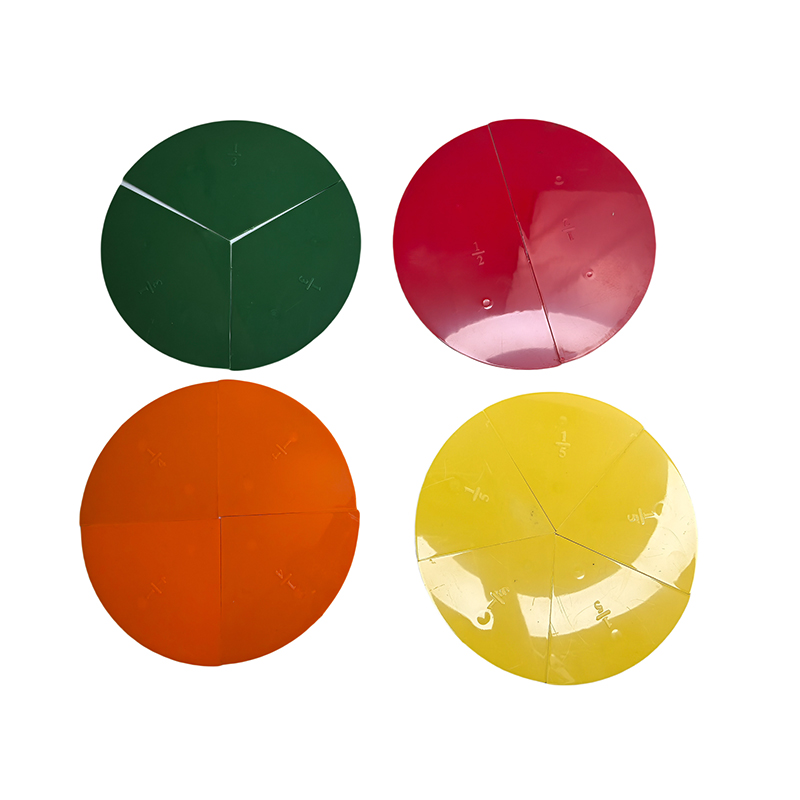 Math Fraction Demonstrator Student Teaching Instrument Model X1276Model X1276 plastic fraction-circle set, Φ200 x 25 mm, 770 g; color-coded parts show halves through twelfths for comparing fractions and simple mixed-denominator work.View Product →
Keep decimal material in the same unit family. Base-ten flats are already a hundredths grid, so a class that reads them as 0.01 can move from fractions to decimals to percentages without changing tools.
Transparent 3D solids earn their place when the base comes off. A pupil who fills a hollow prism and pours it into a pyramid sees the one-third relationship instead of memorising it. Check for a positive click fit and a wall of at least 1.5 mm; thin shells crack along the seam within a term.
 12 Piece Transparent 3D Geometric Solid Model SetModel X1287 plastic 12-piece transparent geometric solid set, 290 x 230 x 65 mm; includes cylinder, cube, rectangular prism, and cone for spatial geometry.View Product →
For construction work, the compass matters more than the set it arrives in. A locking radius nut keeps the arc clean, while a friction hinge drifts mid-circle. Magnetic teaching rulers should be about 5 cm wide with a bevelled reading edge so the demonstration carries to the last row, and student protractors, triangle rulers and tape measures should all use the same graduation spacing.
Probability kits fail quietly. A die that is 0.2 g off centre produces a distribution that looks plausible and is wrong, and a spinner whose needle drags biases every result in the set. Favour spinners with a metal pivot and a freely turning needle over a moulded plastic one.
Countability matters as much as accuracy. A compartment tray that shows at a glance whether all 30 dice came back saves ten minutes at the end of every lesson, and a kit that is quick to check is a kit that gets used.
Before a tender goes out, ask for the production sample rather than the display piece, a dimensional drawing, material data for the polymer, and the certificate set — ISO 9001 for quality, ISO 14001 for environment, GB/T 28001 for occupational health and safety. We hold all three, so a delivered order can be traced back to a mould and a batch.
If you are still deciding what belongs in the first order, our note on selection criteria for school laboratory instruments applies the same logic to the other science subjects. For a maths list matched to your grade levels, send us your class sizes and current inventory and we will mark which items already match it.
Plan for 30 individual sets plus six demonstration pieces. Most breakage happens when pupils share, not when they work alone, and a spare tray of ten extra rods costs less than replacing a full set later.
Hardwood feels better and lasts in dry rooms, but it swells in humid stores and the dimensions move with the seasons. Plastic holds tolerance and can be washed, so for coastal and tropical schools it is usually the safer specification.
They should share the unit length and colour code even when the components differ. Keeping that one detail constant removes a surprising amount of re-teaching in year 7.
None of this needs a bigger budget. It needs a specification short enough to fit on one page, and a sample that has been clicked together, measured and dropped on the floor before the order is placed. Do that, and the next carton of 400 bricks will do what the last one was supposed to do.
Recommended Products



+86-18630650508 +86-0574-62500588

+8618630650508

 No. 588, Chaoyang South Road, Ditang Street, Yuyao, Ningbo City, Zhejiang Province, China


 English
 русский
 Español